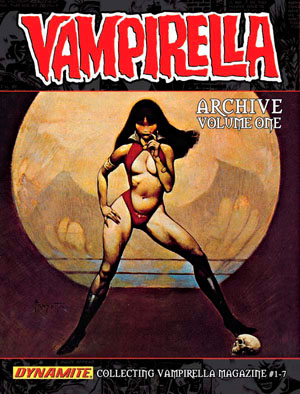
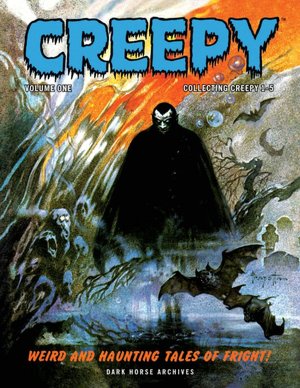
Creator of Vampirella, Co-Editor of Famous Monsters of Filmland, Inventor of the term, "Sci-Fi," Forrest J (no period) Ackerman is a man worthy of recognition. To celebrate his life and creativity, I am sharing his obituary from the New York Times because it enthusiastically sums up Ackerman's many passions. For even more info about Ackerman, check out the Time article, "Sci-Fi's No. 1 Fanboy, Forrest J Ackerman, Dies at 92."

December 6, 2008
Forrest J Ackerman, High Elder of Fantasy Fans, Is Dead at 92
Forrest J Ackerman, High Elder of Fantasy Fans, Is Dead at 92
 |
| Forrest J Ackerman at his home in Hollywood, California |
By Bruce Webber
It’s a common claim that someone is the world’s biggest fan of such-and-such. Elizabeth Taylor’s biggest fan. The biggest fan of the New York Jets. The world’s biggest country music fan. Hardly anyone takes such a designation seriously, except, perhaps, when it comes to Forrest J Ackerman, whose obsessive devotion to science fiction and horror stories was so fierce that he helped propel their popularity. Indeed, he was widely credited with coining the term sci-fi.
Mr. Ackerman died on Thursday at his home in Los Angeles. He was 92. The cause was heart failure, The Associated Press reported, quoting Kevin Burns, who is head of the production company Prometheus Entertainment and a trustee of Mr. Ackerman’s estate.
In the cultural niche defined by monsters, rocket ships and severed body parts, Mr. Ackerman was decreed by acclamation to be its leading citizen. He was a film buff, an editor of pulp magazines and anthologies, a literary agent for dozens of science fiction writers and an amateur historian. No one has evidently disputed his claim that he created the expression sci-fi.
He was also an omnivorous memorabilia collector who once turned a former home of his overlooking Los Angeles into a sort of scream-a-torium. Thousands of science-fiction fans made pilgrimages to the house, a repository of more than 300,000 books, posters, masks, costumes, statuettes, models, film props and other artifacts. (He sold the house several years ago to pay for mounting medical bills.)
“He was the world’s biggest fan,” the writer Stephen King said in a recent phone interview. “If you had been to his house, you wouldn’t doubt it.”
Mr. Ackerman’s appetite for science fiction embraced the highbrow as well as the low. His favorite film, he often said, was Fritz Lang’s futuristic masterpiece from 1927, “Metropolis.” He said he had seen it nearly 100 times. In 2002, when he received a lifetime achievement award at the World Fantasy Convention, he shared honors with one of the most admired writers of fantasy and science fiction, Ursula K. Le Guin, whose book “The Other Wind” was named the year’s best novel.
But Mr. Ackerman spent most of his time in the arena of pop culture. Between 1958 and 1983, he wrote and edited Famous Monsters of Filmland, a seminal black-and-white magazine heavily illustrated with photographs from Mr. Ackerman’s collection. The magazine emphasized the scream-worthy features of movies and was fond of groan-worthy wordplay. “Menace, Anyone?” was a typical title. But it also conveyed the idea that language was flexible and that using it could be fun.
The magazine fired the imaginations of generations of young horror fans, including Mr. King and the filmmakers George Lucas and Joe Dante (“Gremlins”).
“When you think of the size of the business, the dollar amount, that has sprung up out of fantasy, the people who made everything from ‘Star Wars’ to ‘Jaws,’ ” Mr. King said, “well, Forry was a part of their growing up. The first time I met Steven Spielberg, we didn’t talk about movies. We talked about monsters and Forry Ackerman.”
Forrest James Ackerman (he used his middle initial, but without the period) was born in Los Angeles on Nov. 24, 1916. His father was a statistician for an oil company. He saw his first science-fiction film in 1922: “One Glorious Day,” the story of a disembodied spirit that takes over the soul of a tired professor, played by Will Rogers. Four years later he discovered science-fiction magazines, starting with Amazing Stories, and began collecting them and science-fiction memorabilia. His collection eventually included more than 40,000 books and 100,000 film stills.
His wife, Wendayne, a teacher who translated many science-fiction novels from French and German into English, put up with the collection but restricted it to the lower floors of the house, which in the science-fiction world was known as the Ackermansion, in Horrorwood, Karloffornia. (After her death in 1990, the collection began creeping up the stairs.)
The couple had no children, and Mr. Ackerman leaves no immediate survivors.
After serving in the Army during World War II, he started a literary agency that eventually represented, by his count, 200 writers, including, at different times, Ray Bradbury, H. P. Lovecraft and L. Ron Hubbard, who later founded Scientology.
Mr. Ackerman said he came up with “sci-fi” in 1954. He was driving in a car with his wife when he heard a radio announcer say “hi-fi.” The term sci-fi just came reflexively and unbidden out of his mouth, he said.
Over the years he published as many as 50 short stories of his own, wrote most of the articles in Famous Monsters himself under pseudonyms like Dr. Ackula and wrote and edited many other magazines with titles like Monster World. At his induction into the Horror Hall of Fame in 1990, the actor Robert Englund (a k a the serial killer Freddy Krueger in the “Nightmare on Elm Street” films) introduced Mr. Ackerman as “the Hugh Hefner of horror.”
Mr. Ackerman also invented the comic character Vampirella. And as testimony to his ubiquitous presence, he acted (sort of) in more than 50 films, almost always as an extra. His longest screen appearance was a two-minute scene in which he played the president of the United States in the science-fiction spoof “Amazon Women on the Moon” (1987).
“He was an appreciator, a collector, not a creator,” Mr. King said. “Well, he was a creator in the sense that with the magazine he gave us a window into a world we really wanted to see. He was our Hubble telescope.”