Showing posts with label 1983. Show all posts

Friday, February 10, 2012

Vampirella Archives HC Collection

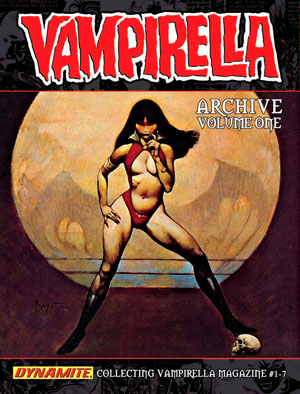
Vampirella Archives Vol. 1, cover art by Frank Frazetta

Warren Publishing Continued ... Part 4

In 1967, Warren Publishing underwent something of a crisis.  They were short on funds, writers and artists came and went.  Instead of new stories, reprints often had to suffice for both Creepy and Eerie.  This was known as a dark period for Warren.

But in 1969, things began to look up for the publisher.  A new influx of cash, new writers and artists, plus returning of old ones heralded a new day.  But what really signaled a change in fortune for James Warren and Company was the launch of the third horror magazine - Vapirella.

Vampirella was the creation and collaboration of Forrest J Ackerman, friend and fellow publisher with Jim Warren, and Trina Robbins.  Forrest wrote the first story and Trina designed the distinctive hairstyle and skimpy costume of Vampirella.  Like Uncle Creepy and Cousin Eerie, Vampirella was to serve as host for the new magazine, but soon she became so popular that she became a character within the stories of the magazine.

Vampirella was no ordinary vampire.  She was an alien.  Born on the planet Drakulon, she came from a race of vampires who were sustained by rivers of blood which ran throughout the planet.  But alas, because of the twin suns of her solar system, the planet was doomed.  Vampirella survived when an American astronaut landed on her planet.  When she discovered that blood ran through the veins of human beings, she commandeered the space craft and returned to Earth.  Soon, she became a "good" vampire and frequently did battle with the forces of evil.

Vampirella was a success.  Like Creepy and Eerie before it, the magazine drew some of the finest talent of the day: Archie Goodwin, Frank Frazetta, John Severin, Alex Toth, Carmine Infanto, Russ Heath, Doug Moench, Bernie Wrightson, Barry Windsor Smith, Jose Gonzales, Frank Brunner, Mike Ploog, Wally Wood and a host of others.  Also, there was a period when a number of Spanish artists were employed.
Frank Frazetta's rendition of Vampirella

Vampirella, like her sister magazines, had a very good run, which ended in 1983 when Warren Publishing went into bankruptcy.  Harris Publications obtained the rights to Warren's library and titles in August of that year.  After a protracted lawsuit, Jim Warren regained the rights to Creepy and Eerie, but not Vampirella.  This remained a Harris property until 2010 when Dynamite Entertainment secured the rights to the character, title, and past magazine publications.  Fortunately, like Dark Horse with Creepy and Eerie, Dynamite Entertainment began to publish the entire Vampirella archives in hardback form in January 2011, featuring the first seven issues.  Three volumes have been published thus far and Vol. 4 is due soon.

Creepy Archives HC Collection

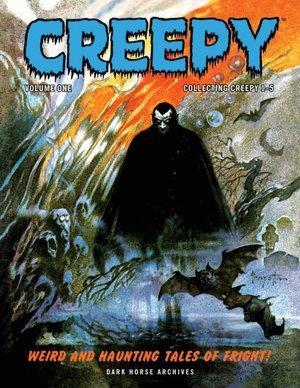
Creepy Archives Vol. 1; Cover painted by Frank Frazetta

Warren Publishing Continued ... Part 2

Warren Publishers first break-out success was Creepy in 1964.  It was published in magazine format, larger than that of regular comics.  It also cost $.35 as opposed to the usual $.12.  It was published in glorious black & white which brought a unique atmosphere to the horror tales contained within.

Originally published quarterly, because of popularity it quickly moved to a bi-monthly basis.  Jim Warren was more than just a publisher, he was very hands-on in his approach to Creepy.  One of his best assets was luring some of the best writers and artists at the time to work for him.  Much of the early success of the horror magazine was the leadership of Archie Goodwin, who came on as editor in 1965.  Some of the writers and artists who worked for Warren Publishing over the years include: Alex Toth, Frank Frazetta, Joe Orlando, Wally Wood, Neal Adams, Steve Ditko, Angelo Torres, Al Williamson, Carmine Infanto and too many others to name.

Uncle Creepy
This 48-page horror magazine was hosted by none other than Uncle Creepy, who introduced stories and generally guide the reader through the issue.  Creepy was not just EC Comics resurrected under another name, it was it's own creation.  That said, it did employ some of the storytelling techniques that has mad EC Comics so popular.

Creepy debuted in late 1964 and ended in February 1983, with a total run of 145 issues.  These issues are now very rare and hard to come by.  Fortunately, a group of creators and investors, New Comic Company LLC, reached a deal with Jim Warren in 2007 acquiring all rights to publication for Creepy, as well as it's sister magazines, Eerie and Vampirella.  They soon merged with Dark Horse and in 2008, the first archive edition of Creepy was published, containing the first five issues of the magazine.  These hardback archived editions are absolutely beautiful.  Check them out for yourself.

Warren Publishing, 1957-1983

Famous Monsters of Filmland #56, 1969

Warren Publishing, 1957-1983

When you think of comic publishers of the 1960s and 1970s, who do you think about?  DC?  Marvel? Dell?  Charlton?  Gold Key?

Here's one you may have forgotten, but is very important to the history of comics - Warren Publishing.  Started by James Warren in 1957, he published a series of comic-oriented magazine titles.  The reason that they were published in magazine format was to be free from the constraints of the Comic Code Authority, established in the 1950s.

Warren's first major hit was a title called, Monsters of Filmland.  It was the first such magazine aim which focused on the horror movie industry.  It began in 1958 and ran until 1983, reaching 191 issues.  Warren co-edited this magazine with the well known science fiction aficionado, Forrest J Ackerman.  Ackerman is known for many things, but least of which is coining the term "Sci-Fi" for science fiction.

Infamous cover of Crime SuspenStories
By the early 1960s, Warren was inspired by the 1940s-1950s horror comics publisher, EC Comics.  EC was at the center of the famous controversy promoted by Dr. Frederic Wertham that comic books were increasingly detrimental to the lives of youth.  He argued that the violence, sexuality, and horror depicted in many comics caused depravity in youth.  Wertham wrote a controversial best-seller entitled, "Seduction of the Innocent" in 1954.  Congressional hearings were held.  Comic book burnings ensued.  Then the top comic book publishers came together and established The Comic Code Authority, which strictly enforced the new mandates and encouraged a new conformist and positive outlook in comics.  EC Comics, published by Maxwell Gaines and his son, William Gaines, ceased publishing all of its horror comics rather than be censored.  The only comic to survive was Mad Magazine, which ironically led to great financial success.

Warren wanted to re-establish the horror genre in comics publishing.  But instead of publishing in regular comic book format, he chose the route of the magazine format, which allowed him to circumvent the rules of the Comic Code Authority.  His three most famous and successful horror magazines were: Creepy (1964-1983), Eerie (1966-1983) and Vampirella (1969-1983).  More about these in the next three postings.